
Please Choose Your Language


Views: 0 Author: Site Editor Publish Time: 2026-08-17 Origin: Site


Understanding the mechanics of a commercial fast-charging site is no longer just for engineers. It is now a mandatory prerequisite for facility managers, fleet operators, and commercial property owners evaluating infrastructure investments. The electrification of transport demands rapid turnaround times to remain viable.
Unlike standard AC charging, alternating current methods rely entirely on the vehicle’s internal converter. Fast-charging infrastructure delivers direct power instead. This approach requires robust external hardware, complex thermal management, and careful site planning. Grid constraints and hardware selection present major hurdles for newcomers. If you misjudge site capacity, you risk stranded assets and severe grid upgrade delays.
This comprehensive guide breaks down the technical operations, hidden infrastructure requirements, and procurement criteria you need today. You will learn how to bypass common engineering pitfalls. We will show you how to confidently evaluate and implement commercial fast-charging solutions effectively.
Bypassing the OBC: DC chargers perform the AC-to-DC power conversion externally, bypassing the vehicle's onboard charger (OBC) to deliver rapid power directly to the battery.
Infrastructure Impact: High-capacity stations require significant grid upgrades; assessing site power availability is the critical first step before hardware procurement.
Software is as Critical as Hardware: Reliable operation depends on continuous, real-time communication between the charger, the vehicle’s Battery Management System (BMS), and cloud-based load management platforms.
Scalability Matters: Standardizing on modular equipment (e.g., a scalable 120kW EV charger) ensures infrastructure can grow alongside fleet demands without complete hardware replacement.
To fully grasp how fast-charging architecture operates, you must first understand the limitations of traditional charging methods. The primary difference lies in where the actual power conversion takes place.
Electrical grids transmit power as Alternating Current (AC). However, lithium-ion batteries can only store power as Direct Current (DC). When you plug a vehicle into a standard AC wall box, the AC power flows into the vehicle. The car uses a built-in component called the On-Board Charger (OBC) to convert this AC power into DC.
This internal conversion creates a massive bottleneck. Automakers design OBCs to be as small and light as possible. Heavy converters reduce vehicle range and take up valuable space. Because of these physical constraints, an OBC can only process a limited amount of power at once. This limitation strictly caps the maximum charging speed, regardless of how much power the grid can supply.
An EV DC charging station solves this bottleneck by moving the conversion process outside the vehicle. Instead of relying on the car's small OBC, the station houses massive, heavy-duty rectifiers internally. These rectifiers pull AC power from the grid, convert it to high-voltage DC instantly, and push it directly into the vehicle's battery array. By bypassing the vehicle’s internal components, commercial stations can deliver massive amounts of energy in a fraction of the time.
Many new operators assume that fast charging delivers power at a constant, linear rate. It does not. DC power delivery follows a strict charging curve to protect battery chemistry. When a battery is nearly empty, it can accept a massive influx of electrons. However, as the battery fills up, internal resistance increases.
If the station continues pushing maximum power into a nearly full battery, it generates dangerous heat. This excess heat leads to thermal degradation and lithium plating, which permanently damages battery health. To prevent this, the charger actively ramps down the power output once the battery reaches 80% capacity. The final 20% often takes as long as the first 80%. Understanding this curve helps fleet operators plan realistic turnaround times.
Charging Technology Comparison Chart
Feature | Standard AC Charging | DC Fast Charging |
|---|---|---|
Conversion Location | Inside the vehicle (OBC) | Inside the external station |
Power Delivery Speed | Slow to Moderate (Linear) | Extremely Fast (Non-linear curve) |
Hardware Footprint | Compact and lightweight | Large, robust external cabinets |
Primary Use Case | Overnight or workplace parking | Highway corridors and fleet depots |
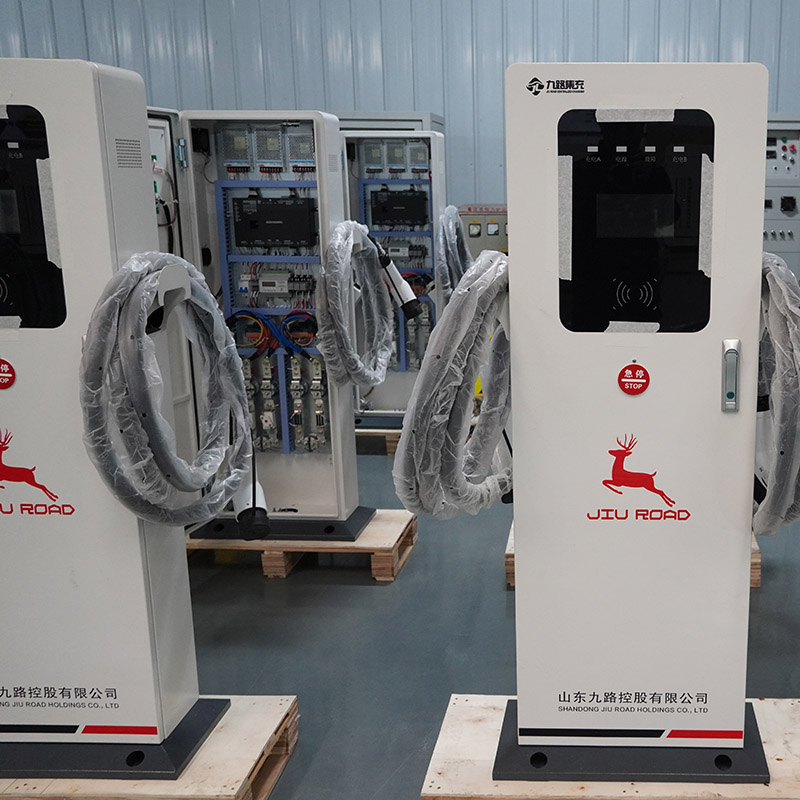
A commercial fast-charging unit is a sophisticated piece of industrial machinery. It combines high-voltage electrical engineering with sensitive communication electronics. Let us examine the internal components that make rapid power delivery possible.
At the heart of the equipment sit the power modules. Manufacturers rarely build a single massive converter. Instead, they stack multiple smaller power modules together inside the cabinet. A typical module might handle 20kW or 30kW of power.
These internal modules operate as active rectifiers. They take the incoming AC waveform and flatten it into a steady DC output. Stacking them provides redundancy. If one 30kW module fails, the station can often continue operating at a reduced capacity rather than shutting down entirely.
Pushing hundreds of amps of electrical current generates immense heat. Thermal management is critical for safety and performance. Commercial stations utilize active cooling systems to maintain safe operating temperatures.
Internal fans and heat sinks cool the power modules. However, the charging cables require even more advanced solutions. High-capacity stations often employ liquid-cooled cables. Pumps circulate a specialized coolant mixture through tubes running alongside the copper wires. This technology keeps the cables cool to the touch and allows manufacturers to make the cables thinner and easier for drivers to handle.
To understand the physical reality, consider a standard 120kW EV charger. This equipment serves as an excellent benchmark for commercial deployment. It typically features a footprint roughly the size of an industrial refrigerator. It requires a dedicated concrete pad for secure mounting.
In a commercial use case, a 120kW unit perfectly balances speed and infrastructure demands. It can comfortably recharge a standard delivery van or passenger vehicle in under an hour. Fleet depots frequently deploy these specific models because they provide rapid turnaround without requiring the extreme grid upgrades associated with 350kW ultra-fast stations.
Power delivery requires strict supervision. The charger cannot simply force electricity into the car. The station and the vehicle must establish a secure digital handshake. Once you plug the cable in, the equipment communicates directly with the vehicle’s Battery Management System (BMS).
The BMS acts as the brain of the battery pack. It dictates the exact voltage and current it requires at any given second. If the battery gets too warm, the BMS instructs the station to lower the current. The station complies instantly. This real-time feedback loop ensures maximum safety during every session.
Procuring hardware represents only one piece of the puzzle. The most significant challenge in deployment involves preparing your site to handle massive electrical loads.
Commercial fast-charging sites demand serious power. Standard residential or light-commercial electrical panels simply cannot support these systems. A dedicated DC EV charging station requires high-voltage commercial connections, typically 480V 3-phase power.
Facility managers must conduct rigorous power audits before purchasing equipment. You need to verify exactly how much spare capacity your current utility feed holds. If your building already operates near maximum capacity, adding fast-charging infrastructure will overload your system immediately.
Most commercial deployments require significant hidden infrastructure. The physical charging pedestal is just the tip of the iceberg. You will likely need to install a dedicated step-down transformer to match the exact voltage requirements of the charging hardware.
Additionally, you must install upgraded switchgear. Switchgear protects the electrical circuits from overloads and faults. Preparing this infrastructure requires extensive trenching, conduit laying, and concrete work. You must factor these civil engineering tasks into your project timeline.
Upgrading grid capacity takes months and requires heavy capital investment. Fortunately, software offers a smart alternative. Dynamic Load Management (DLM) software intelligently distributes available power across multiple dispensers.
Imagine your site only has 150kW of available grid capacity, but you install two 100kW stations. If two vehicles plug in simultaneously, they would demand 200kW, tripping your main breaker. DLM software prevents this. It monitors the total load in real-time. It will automatically throttle each station down to 75kW. Both vehicles charge safely, and your facility avoids exceeding its maximum power threshold. This technology mitigates peak demand charges and eliminates grid overload risks.
The electric vehicle industry relies on a complex web of regional standards and safety protocols. Navigating these requirements ensures your investment remains relevant and safe for years to come.
Vehicles utilize different physical plug types depending on their manufacturer and geographic region. Understanding these protocols prevents interoperability issues.
CCS (Combined Charging System): The dominant standard in Europe (CCS2) and widely used in North America (CCS1) for non-Tesla vehicles. It combines AC and DC pins in one large plug.
CHAdeMO: An older standard pioneered by Japanese automakers. While still active in legacy vehicles, the global market is rapidly phasing it out.
NACS (North American Charging Standard): Originally developed by Tesla, this sleek connector is rapidly becoming the universal standard across North America, with major automakers committing to its adoption.
Commercial charging equipment sits outdoors, exposed to extreme weather and public interaction. Strict compliance ratings are non-negotiable.
First, verify electrical safety certifications like UL 2202 in North America or CE marks in Europe. These certify the equipment will not cause electrical fires. Next, check the ingress protection (IP) and impact protection (IK) ratings. A robust station should feature an IP54 or IP65 rating to resist heavy rain and dust infiltration. An IK10 rating ensures the outer shell can withstand vandalism and accidental impacts.
Furthermore, physical accessibility remains crucial. Deployments must comply with ADA (Americans with Disabilities Act) guidelines. This dictates the maximum height of payment screens and ensures cables are light enough for individuals with limited mobility to maneuver.
Hardware interoperability goes beyond physical plugs; it extends to software. The Open Charge Point Protocol (OCPP) is a universal communication language between the hardware and the cloud management platform.
You must mandate OCPP compliance when purchasing equipment. Proprietary networks lock you into a single software vendor forever. If that vendor raises software fees or goes bankrupt, your hardware becomes useless. OCPP guarantees you own the data. It allows you to switch software providers at any time without replacing the physical station.
Selecting the right hardware requires looking past the spec sheet. Facility managers need a reliable framework to evaluate different manufacturers and ensure long-term operational success.
Technology evolves rapidly, and fleet demands increase over time. Buying rigid, non-upgradable equipment leaves you vulnerable to obsolescence. A superior DC EV charger features a highly modular internal architecture.
Modular systems allow you to scale power output seamlessly. For example, you can purchase a large chassis populated with only 60kW of power modules today. As your fleet transitions to larger battery vehicles next year, you simply slot additional power modules into the existing empty bays. You scale the unit up to 120kW or 180kW without undertaking expensive civil engineering work or replacing the entire outer shell. This modularity future-proofs your site.
A fast-charging station is completely worthless if it constantly sits offline. Public charging networks frequently suffer from poor reliability due to inadequate vendor support. You must establish clear success criteria for reliability before signing any procurement contracts.
We recommend evaluating vendors based on the following critical support factors:
Service Level Agreements (SLAs): Demand a strict SLA guaranteeing at least 97% operational uptime.
Remote Diagnostic Capabilities: Ensure the vendor’s software can diagnose faults remotely. Many software errors can be resolved with a simple remote reboot, avoiding costly technician dispatch.
Local Technician Networks: Verify the manufacturer maintains a certified repair network in your specific geographic region. If parts must ship from overseas, your station may remain offline for weeks.
Parts Availability: Ask the vendor about their supply chain. Modular designs allow local technicians to swap out a single faulty power block quickly while the rest of the unit continues functioning.
Do not compromise on vendor support. A beautifully designed outer cabinet means nothing if the manufacturer abandons you after the initial installation.
Deploying a commercial fast-charging network is a highly complex integration project. It requires bridging the gap between high-voltage electrical engineering, sensitive software communication, and strategic site planning. As we have explored, external power conversion, advanced thermal management, and strict compliance standards define the realities of modern charging infrastructure.
Your next steps dictate the success of your project. Do not immediately issue an RFP for hardware. Instead, initiate a comprehensive site power audit first. Partner with a licensed commercial electrician or a specialized EPC (Engineering, Procurement, and Construction) firm. Let them determine your true grid capacity and hidden infrastructure needs. Once your site realities are clear, you can confidently procure modular, OCPP-compliant equipment that scales alongside your long-term goals.
A: The primary difference is where power conversion occurs. Level 2 supplies AC power to the vehicle, relying on the car's small onboard charger to convert it to DC. This results in slower charging times (hours). DC fast charging converts AC to DC externally inside massive station hardware, bypassing the vehicle entirely. This delivers rapid power directly to the battery, allowing commercial turnaround times in minutes.
A: Commercial stations demand significant electrical capacity, typically requiring 480V 3-phase power. Realistic ranges span from 50kW for entry-level fleet applications up to 350kW or more for highway corridor ultra-fast charging. Sites usually require dedicated transformers and upgraded switchgear to support these massive loads safely.
A: Yes, provided the connector plug matches. However, the vehicle will not necessarily charge at 120kW. The vehicle's Battery Management System (BMS) dictates the maximum power draw based on its internal limits and battery health. If a car is capped at 50kW, the station will intelligently lower its output to deliver exactly what the vehicle requests.
A: Routine maintenance is vital for high-voltage equipment. Typical procedures include checking cooling fluid levels in liquid-cooled cables, replacing air filters to prevent internal overheating, and inspecting heavy cables for physical wear-and-tear. Additionally, regular over-the-air software updates are required to maintain OCPP communication security and vehicle handshake compatibility.


